Wearable Tech: Which Fitness Metrics Are Actually Useful?
The Data Overload Problem: Are You Tracking Too Much?
Wearables have shifted from single metrics to multi layer monitoring systems. That expansion increases visibility, but also complexity.
A typical device processes optical heart rate, accelerometer data, temperature signals, and timing patterns from sleep and activity. These inputs are then converted into both raw values and derived scores such as recovery, stress, or readiness. The complication is that many of these outputs are mathematically linked. A change in heart rate variability can influence stress, recovery, and readiness at the same time. When displayed together, they appear as separate insights, even though they originate from the same physiological adjustment.
Another constraint is how variability is represented. Human physiology is not static, and short term fluctuations are normal. Devices, however, often highlight these fluctuations in daily summaries without sufficient context. A minor shift in sleep timing or cardiovascular response can trigger visible changes across several metrics. Without baseline comparison over longer periods, it becomes difficult to distinguish routine variation from meaningful deviation.
Primary sources of data overload:
- Multiple metrics derived from shared sensor inputs
- Continuous recalculation based on small input changes
- Equal emphasis on measured values and modeled scores
- Limited visibility of long term baseline trends
Interpretation becomes the limiting factor rather than data availability. As more variables are introduced, the effort required to understand relationships between them increases, reducing the practical clarity of the system.
Heart Rate: The Core Metric Behind Almost Everything
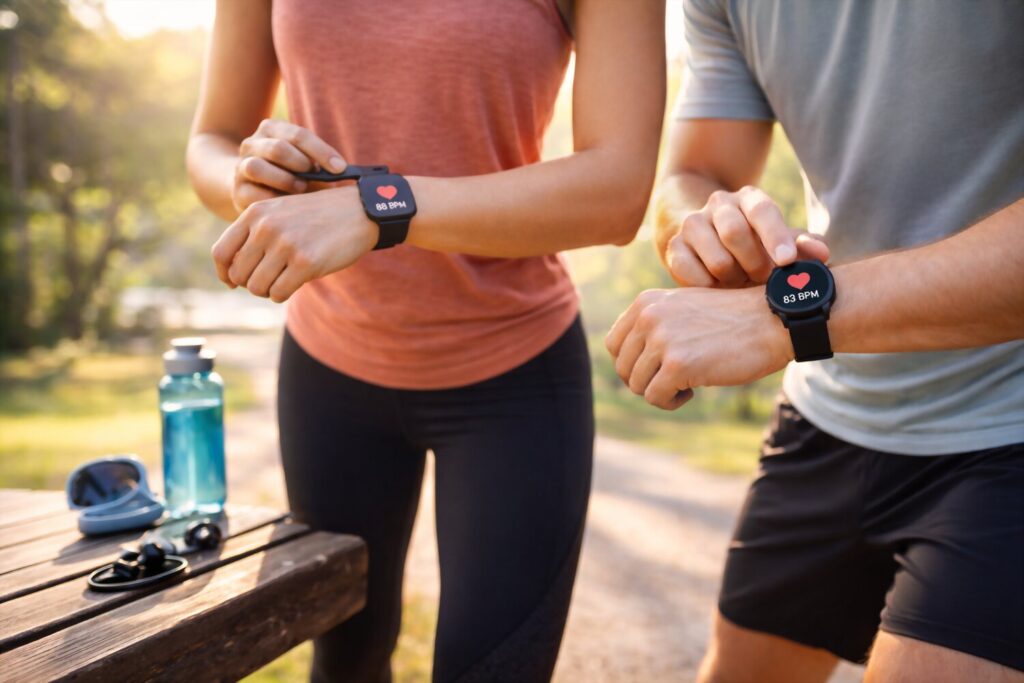
Heart rate is one of the most fundamental signals captured by wearable devices. It serves as the basis for many other metrics, both direct and derived.
Unlike step count, heart rate reflects internal physiological response rather than external movement. Optical sensors measure blood flow changes through the skin, allowing continuous tracking throughout rest, activity, and sleep. This makes heart rate a dynamic indicator that responds to intensity, environmental conditions, and internal states such as fatigue or stress. Because it changes in real time, it provides a more immediate view of how the body is reacting to different demands.
The importance of heart rate lies in how widely it is used across wearable systems. Many advanced metrics rely on it as a primary input. Calories burned, training load, stress scores, and even sleep analysis often incorporate heart rate data into their calculations. This creates a dependency structure where the accuracy of multiple outputs is tied to the quality of a single signal. Small variations or measurement noise can propagate through several metrics, affecting their consistency.
Key roles of heart rate in wearable tracking:
- Measures real time physiological response to activity
- Acts as the primary input for many derived metrics
- Reflects changes in intensity and effort
- Supports trend analysis across different conditions
Another important dimension is resting heart rate. This value, typically measured during periods of minimal activity, is less influenced by immediate external factors and more reflective of baseline cardiovascular state. Over time, patterns in resting heart rate can provide insight into adaptation or accumulated strain, especially when compared against individual historical data rather than generalized averages.
Heart rate variability extends this concept further. Instead of counting beats, it analyzes the timing between them, offering additional detail about autonomic regulation. Together, these related signals form a layered system where heart rate provides the foundation, and more complex metrics build on top of it.
Heart Rate Variability: A Subtle Metric with High Informational Value
Heart rate variability, often abbreviated as HRV, measures the variation in time between consecutive heartbeats. Unlike heart rate, which counts beats per minute, HRV focuses on the timing between those beats.
This metric reflects the balance within the autonomic nervous system. The sympathetic branch is associated with activation, while the parasympathetic branch is linked to recovery processes. HRV captures how these systems interact rather than measuring one in isolation. Because of this, it is sensitive to multiple internal and external factors, including physical exertion, sleep patterns, and environmental stressors. Small changes in these factors can produce measurable differences in HRV, even when other metrics remain stable.
What HRV Represents in Wearable Data
HRV is not a direct indicator of a single condition. It is better understood as a composite signal that reflects overall physiological regulation. Wearables typically measure HRV during rest periods, especially during sleep, when external variables are minimized.
Key characteristics of HRV:
| Aspect | Description |
|---|---|
| Measurement basis | Time variation between heartbeats |
| Sensitivity | Responds to stress, recovery, and fatigue |
| Variability range | Highly individual and influenced by baseline |
| Data stability | More meaningful across trends than single values |
Interpretation depends heavily on context. Absolute HRV values vary widely between individuals due to genetics, age, and cardiovascular conditioning. A value that appears low in one case may be typical in another. This makes cross user comparison unreliable.
Temporal patterns provide more insight than isolated readings. Day to day fluctuations are common and expected. What becomes informative is how HRV behaves over longer periods, particularly when aligned with other signals such as resting heart rate or sleep duration.
Sleep Tracking: Data Rich, Context Limited
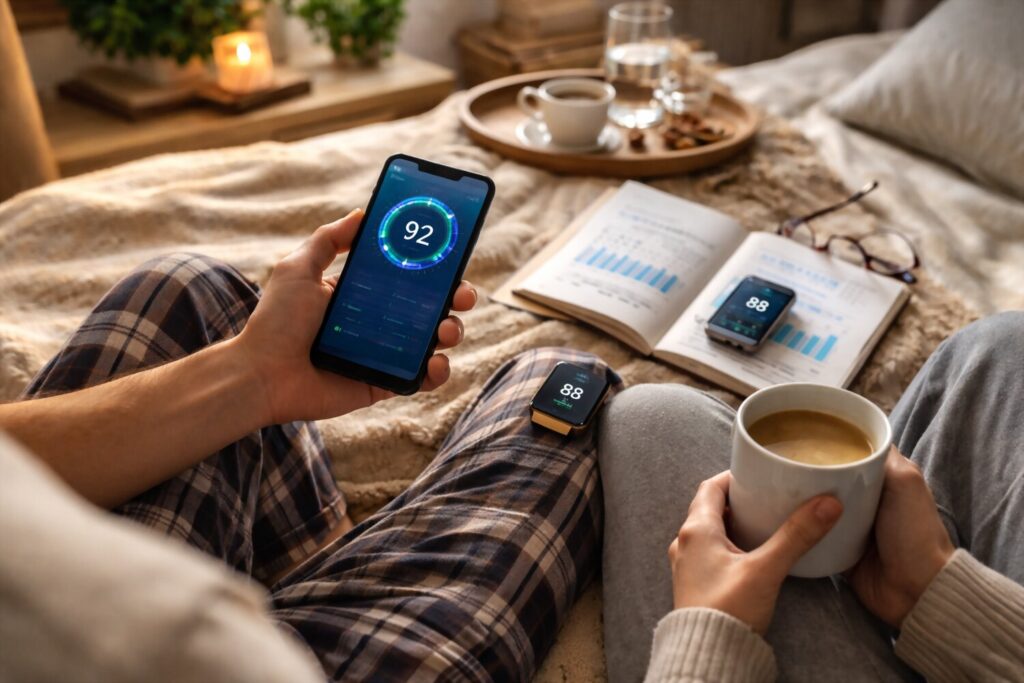
Sleep tracking has become one of the most heavily marketed features in wearable devices. It produces detailed reports that appear highly precise.
Devices estimate sleep using a combination of movement, heart rate, and sometimes respiratory patterns. These signals are used to classify time into stages such as light sleep, deep sleep, and rapid eye movement. While the underlying measurements are continuous, the classification into stages is model based. This means that the final output depends on algorithm interpretation rather than direct observation. As a result, stage breakdowns can vary between devices even when measuring the same night.
What Sleep Tracking Actually Measures
At its core, sleep tracking focuses on patterns rather than exact states. It captures when the body is still, how heart rate changes overnight, and how long rest periods last. These inputs are then translated into structured summaries.
Common components of sleep data:
- Total sleep duration based on inactivity and heart rate patterns
- Sleep timing, including onset and wake periods
- Estimated sleep stages derived from combined signals
- Interruptions or awakenings detected through movement
The limitation is contextual interpretation. A reported decrease in deep sleep or variation in sleep timing may reflect normal biological fluctuation rather than a meaningful change. Environmental factors such as temperature, noise, or device placement can also influence detection accuracy.
Another complexity is consistency versus precision. Sleep metrics are more reliable when viewed as patterns over multiple nights rather than isolated readings. Single night variations can appear significant in dashboards, even when they fall within expected physiological variability.
Calories Burned: The Most Misunderstood Metric
Calories burned is one of the most visible outputs in wearable devices. It appears precise, but it is fundamentally an estimate.
Wearables calculate energy expenditure using a combination of inputs such as heart rate, movement data, body characteristics, and activity classification. These inputs are processed through predictive models that approximate how much energy the body is likely using. The limitation is that energy expenditure cannot be directly measured through wrist based sensors. Instead, it is inferred, which introduces variability depending on the model, the quality of sensor data, and the assumptions built into the algorithm.
Why Calorie Estimates Vary
Even under controlled conditions, calorie estimates can differ significantly between devices. This is because each system applies its own methodology for interpreting the same inputs. Factors such as metabolic efficiency, body composition, and movement patterns influence actual energy use, but are not fully captured by standard wearable sensors.
Primary factors affecting calorie calculations:
- Heart rate response during activity and rest
- Type and intensity of movement detected by accelerometers
- User profile inputs such as age, weight, and height
- Algorithm design and internal assumptions
Another complexity is the distinction between active and total calories. Active calories refer to energy used during movement, while total calories include baseline metabolic processes that occur even at rest. Many devices display both values, but the difference between them is not always clearly explained, which can lead to confusion when interpreting daily totals.
Short term precision is less reliable than long term consistency. Individual daily values may fluctuate due to sensor noise, activity classification errors, or environmental factors. However, when observed over extended periods, calorie estimates can still provide directional insight into changes in activity levels and energy expenditure patterns.
There is also an inherent limitation in how uniform the models are. Most wearable algorithms are designed using population averages rather than individual metabolic data. This means that two people performing the same activity may receive similar calorie estimates, even if their actual energy expenditure differs. As a result, the metric reflects a generalized approximation rather than a personalized measurement.
VO₂ Max: A High Value Metric with Hidden Complexity

VO₂ max represents the maximum rate at which the body can utilize oxygen during intense activity. It is widely used as a proxy for aerobic capacity and cardiovascular efficiency.
Unlike surface level metrics, VO₂ max reflects the interaction between multiple systems. The cardiovascular system delivers oxygen, the respiratory system facilitates gas exchange, and the muscular system uses that oxygen for energy production. Because of this integration, VO₂ max is considered a high level indicator rather than a single signal. In laboratory conditions, it is measured through controlled exercise testing with specialized equipment. Wearables, however, estimate it indirectly using heart rate response, pace, and activity patterns collected over time.
How Wearables Estimate VO₂ Max
The estimation process relies on modeling how the body responds to effort. Devices analyze how quickly heart rate increases relative to movement speed or intensity, then compare this relationship to known physiological patterns.
Key inputs used in VO₂ max estimation:
- Heart rate response during sustained activity
- Speed or pace during walking or running
- Historical activity consistency
- Demographic inputs such as age and sex
This approach produces a useful approximation, but it introduces variability. Environmental factors such as temperature, terrain, and sensor accuracy can influence the inputs, which in turn affects the final estimate. The result is not a direct measurement, but a modeled value based on observed trends.
Another important characteristic is stability. VO₂ max does not change rapidly from day to day. It typically reflects longer term physiological adaptation, which makes it less sensitive to short term fluctuations compared to metrics like heart rate or sleep scores. This stability allows for clearer trend analysis, especially when data is collected consistently over time.
However, interpretation depends on context. Absolute values vary significantly between individuals due to genetics, training history, and body composition. As a result, comparisons across different users provide limited insight. The value becomes more meaningful when evaluated relative to an individual baseline, where gradual changes can indicate shifts in aerobic capacity over extended periods.
Blood Oxygen Saturation: A Stable Metric with Narrow Use Cases
Blood oxygen saturation, commonly labeled as SpO₂, represents the percentage of oxygen bound to hemoglobin in the bloodstream. It is a well established clinical metric, but its role in consumer wearables is more constrained.
In healthy individuals, oxygen saturation typically remains within a tight physiological range. This stability is important from a biological perspective, but it also limits how much variation can be observed in everyday conditions. Unlike heart rate or HRV, which fluctuate in response to activity, stress, or recovery, SpO₂ tends to remain relatively constant throughout the day. Because of this, wearable readings often show minimal change unless external conditions or physiological disruptions are present.
How Wearables Measure SpO₂
Wearables estimate SpO₂ using optical sensors that emit light into the skin and measure how it is absorbed or reflected by blood. The ratio of light absorption at different wavelengths is used to approximate oxygen levels. This method is non invasive, but it is sensitive to external variables.
Factors that influence SpO₂ measurement accuracy:
- Sensor contact quality and device positioning
- Skin temperature and peripheral blood flow
- Motion during measurement
- Ambient light interference
These factors can introduce variability into readings, especially during active periods. For this reason, many devices prioritize measurements during rest or sleep, when conditions are more stable and signal quality is higher.
Another important consideration is interpretability. Because SpO₂ values operate within a narrow range, small numerical differences may not carry meaningful physiological significance. A change of one or two percentage points can result from measurement variability rather than a true shift in oxygen saturation. This contrasts with metrics such as heart rate, where variation is expected and informative.
Typical characteristics of SpO₂ data in wearables:
| Feature | Description |
|---|---|
| Measurement type | Optical estimation of oxygen saturation |
| Normal variability | Low in healthy individuals |
| Sensitivity | Limited to specific conditions |
| Data context | More relevant during rest or sleep |
Context determines relevance. SpO₂ tracking becomes more informative in environments where oxygen availability changes, such as at higher altitudes, or in situations where respiratory patterns are irregular. In standard daily conditions, the metric often remains stable and provides limited additional insight compared to more dynamic indicators.
There is also a structural limitation in how wearables present SpO₂ data. Many interfaces display it alongside more responsive metrics, which can create the impression that it should change frequently. In reality, its value lies in detecting deviations from a stable baseline rather than tracking continuous variation.
Stress Tracking: Interpreting a Complex Signal

Stress tracking in wearables is based on physiological data, not direct emotional measurement. Devices do not detect feelings. They interpret bodily responses.
Most systems rely on heart rate patterns and heart rate variability to estimate stress levels. When variability decreases and heart rate becomes more uniform, the system may classify the state as elevated stress. This reflects activation of the autonomic nervous system, particularly the balance between sympathetic and parasympathetic activity. However, this response is not exclusive to psychological stress. Physical exertion, environmental factors, and even digestion can produce similar patterns in the data.
What Stress Metrics Actually Capture
Stress scores represent a simplified output derived from multiple signals. They are designed to summarize complex physiological behavior into a single value, which improves usability but reduces detail.
Primary inputs used in stress estimation:
- Heart rate variability patterns during rest and activity
- Short term changes in heart rate stability
- Movement data to differentiate rest from activity
- Historical baseline comparisons
Because these inputs overlap with other metrics, stress tracking is closely linked to recovery, sleep quality, and overall physiological load. A change in one area often affects the others, creating interconnected shifts across the system.
Interpretation requires awareness of context. A high stress reading may reflect physical effort rather than psychological strain, while a low reading does not necessarily indicate the absence of mental pressure. The metric captures how the body responds, not the specific cause of that response.
Another limitation is temporal sensitivity. Stress levels can change rapidly within short periods, and wearable devices may reflect these fluctuations in near real time. While this responsiveness provides detail, it can also amplify transient changes that do not represent sustained patterns.
Step Count: Simple Metric, Complex Interpretation
Step count is one of the oldest and most widely recognized metrics in wearable technology. It appears straightforward, but its interpretation involves several layers.
At a technical level, steps are detected using accelerometers that measure repetitive motion patterns associated with walking or running. These sensors analyze changes in movement along multiple axes and apply pattern recognition models to classify motion as steps. While this process is generally reliable for steady walking, accuracy can vary during irregular movement, slow pacing, or activities that involve similar arm motion without actual steps. This includes tasks such as carrying objects or certain types of indoor movement.
What Step Data Actually Reflects
Step count primarily captures locomotion volume rather than intensity or physiological effort. It measures how much movement occurs, not how demanding that movement is for the body.
Key characteristics of step tracking:
- Focuses on quantity of movement rather than effort
- Relies on motion detection algorithms rather than direct measurement
- Sensitive to device placement and arm movement patterns
- Provides consistent data for trend analysis over time
Another dimension is how step data is aggregated. Daily totals are often emphasized, but the distribution of steps across time can vary significantly. Short bursts of activity and evenly distributed movement may produce similar totals while representing very different activity patterns. This distinction is not always visible in summary dashboards.
Context influences meaning. A higher step count may indicate increased movement, but it does not inherently reflect intensity, cardiovascular load, or recovery impact. As a result, step count functions best as a baseline indicator of general activity volume rather than a comprehensive measure of physical exertion.
Recovery Scores: Aggregated Metrics with Layered Assumptions

Recovery scores are composite indicators designed to summarize multiple physiological signals into a single, simplified value. They are widely used in wearable platforms, yet their internal structure is often opaque.
At a technical level, recovery scores combine inputs such as resting heart rate, heart rate variability, sleep duration, and sometimes activity load. Each of these inputs is normalized against an individual baseline, then weighted according to the device’s internal model. The result is a percentage or score that represents how closely current physiological conditions align with previously observed patterns. Because this process involves multiple transformations, the final value is not a direct measurement but a synthesized output derived from layered assumptions.
What Goes Into a Recovery Score
The structure of recovery scoring systems varies between platforms, but most rely on a similar set of foundational signals. These signals are selected because they respond to changes in physiological load and rest.
Common components of recovery metrics:
- Resting heart rate as an indicator of baseline cardiovascular activity
- Heart rate variability as a measure of autonomic balance
- Sleep duration and timing as proxies for rest quality
- Recent activity patterns that influence accumulated load
The interaction between these variables is not linear. A change in one input may have a different impact depending on the state of other inputs. For example, reduced sleep combined with stable heart rate variability may produce a different score than reduced sleep combined with elevated resting heart rate. This interdependence increases complexity and makes the system sensitive to small variations across multiple signals.
Another important aspect is weighting. Each input contributes differently to the final score, and these weights are determined by proprietary models. This means that two devices using the same raw data may generate different recovery scores due to differences in how they prioritize each variable.
Structural Characteristics of Recovery Scores
| Component | Role in Calculation |
|---|---|
| Baseline comparison | Defines normal range for the individual |
| Signal weighting | Determines influence of each metric |
| Temporal smoothing | Reduces short term variability |
| Output scaling | Converts data into a simplified score |
Temporal smoothing is a key mechanism. It reduces the impact of short term fluctuations by averaging data across multiple time points. This creates a more stable output, but it can also delay the reflection of rapid physiological changes.
Interpretation depends heavily on consistency. Recovery scores are most informative when analyzed over time, where patterns in rising or declining values can be observed. Isolated readings provide limited insight due to the aggregated nature of the metric and the multiple layers of processing involved.
Which Metrics Actually Matter Together
Individual metrics provide isolated signals. Their real value emerges when interpreted in combination.
Wearable devices collect multiple streams of physiological and behavioral data simultaneously. Each metric captures a specific dimension such as cardiovascular response, movement, or rest patterns. When these signals are aligned, they form a more coherent representation of underlying processes. For example, a change in resting heart rate alongside reduced heart rate variability and altered sleep duration indicates a coordinated shift across systems, rather than a random fluctuation in a single metric. This layered perspective increases informational density without requiring additional sensors.
How Metrics Interact in Practice
Different metrics often share underlying inputs, which creates overlap but also reinforces patterns when changes occur across several signals at once.
Common interaction patterns:
- Heart rate and heart rate variability both reflect autonomic activity, but from different perspectives
- Sleep duration and recovery scores are linked through shared physiological inputs
- Activity volume and calorie estimates are derived from related movement data
- Stress metrics often overlap with heart rate variability and resting heart rate
This interconnected structure means that no single metric operates independently. Instead, wearables function as integrated systems where outputs are partially dependent on shared data streams. Recognizing these relationships allows for more accurate interpretation of trends over time.
Correlation does not always imply causation. Simultaneous changes in multiple metrics may originate from a single underlying factor, or from unrelated influences that happen to occur together. This complexity is inherent to systems that aggregate physiological signals into simplified outputs.
Another important aspect is consistency across time. Patterns that repeat across multiple metrics tend to carry more informational weight than isolated changes. When several indicators shift in the same direction over consecutive periods, the probability of meaningful underlying change increases within the context of wearable data systems.
Balancing Wearable Tech with Digital Well-Being
As wearable technology becomes more integrated into daily life, another factor is gaining attention: how constant digital interaction affects mental and visual fatigue. Tracking health metrics is only one side of the equation—how we engage with screens matters just as much.
Many users are beginning to recognize that optimizing performance isn’t only about better data, but also about reducing unnecessary digital strain. Small behavioral shifts around screen use can complement wearable insights in a meaningful way.
If you’re interested in practical ways to balance technology and well-being, explore this guide: Simple habits to reduce screen fatigue