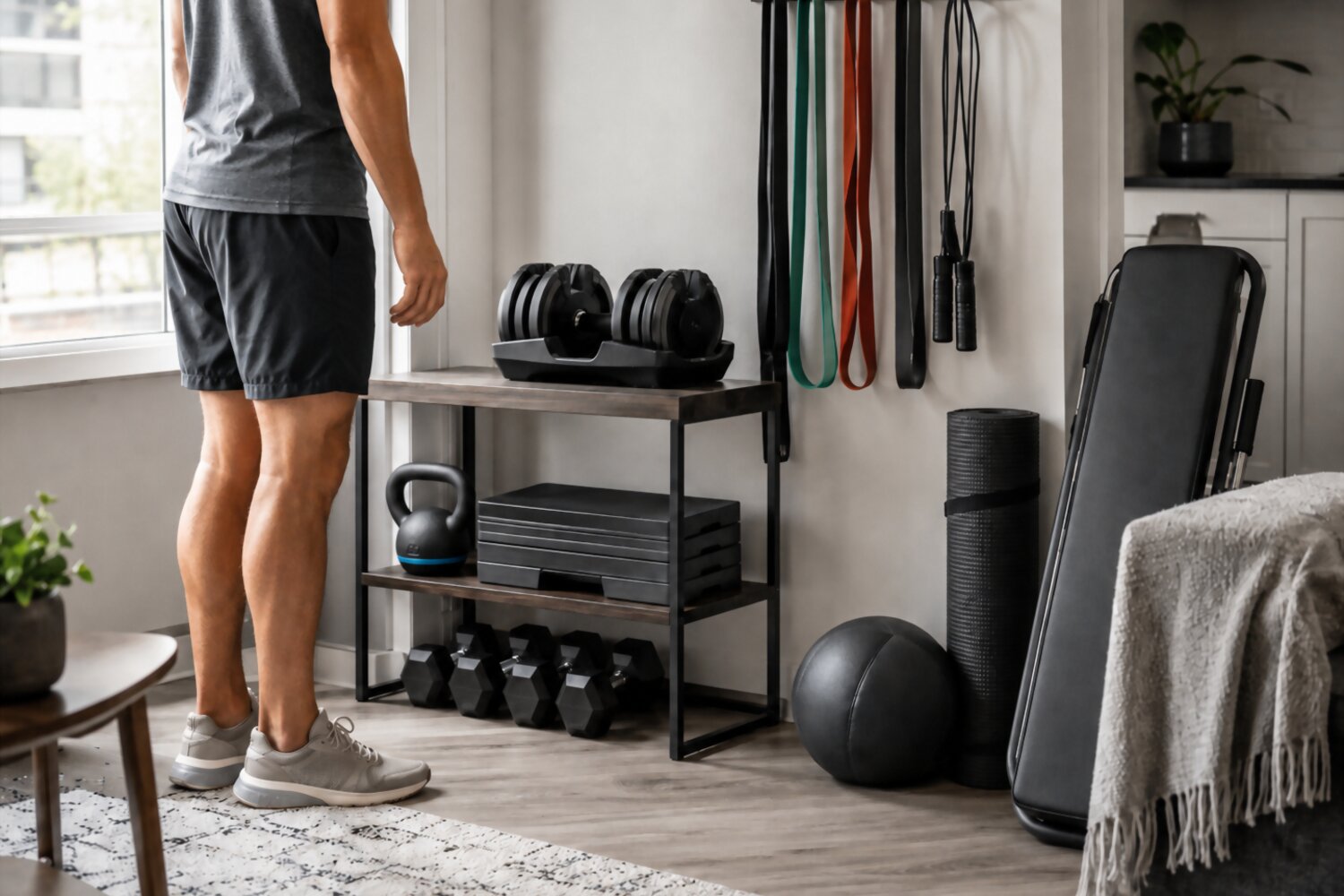
The Best Functional Fitness Equipment for Small Spaces
Why Functional Fitness Works So Well in Small Spaces
Functional fitness is built around movements people use in everyday life: squatting, reaching, lifting, carrying, rotating, balancing, pushing, and pulling. Because these movement patterns rely more on body control, coordination, and adaptable resistance than on large machines, they fit naturally into compact environments.
Unlike traditional gym setups that often separate exercises by muscle group and require dedicated machines, functional training often combines multiple physical skills at once. A single movement may challenge strength, stability, mobility, and endurance together. For example, a loaded carry involves grip strength, posture, core control, and lower-body stability. A resistance-band row can train the back, shoulders, arms, and trunk without needing a cable station.
This is why small-space equipment can be surprisingly effective. Tools such as resistance bands, adjustable dumbbells, kettlebells, suspension trainers, mats, sliders, and compact benches are useful because they support many movement patterns while taking up very little room. Some can fit in a drawer, hang behind a door, or slide under a bed.
Functional fitness also matches the reality of home training.
A small apartment, spare bedroom, office corner, or garage wall does not need to look like a commercial gym to support meaningful movement. The focus is not on filling the room with equipment, but on choosing pieces that create variety.
Key qualities that make functional fitness ideal for small spaces include:
- Multi-use movement patterns: one tool can support several types of exercises.
- Minimal floor space: many movements can be performed on a mat-sized area.
- Scalable resistance: intensity can often be adjusted by weight, band tension, tempo, or range of motion.
- Easy storage: compact tools reduce visual clutter and make the space feel usable outside workouts.
- Movement variety: strength, balance, mobility, and conditioning can all be trained with a limited setup.
In a small space, the best equipment is not always the biggest or most expensive. It is the gear that helps create the most training possibilities with the least amount of storage demand. Functional fitness succeeds in compact rooms because it turns limited square footage into a flexible training zone rather than a barrier.
The Small-Space Equipment Rule: Versatile Beats Bulky
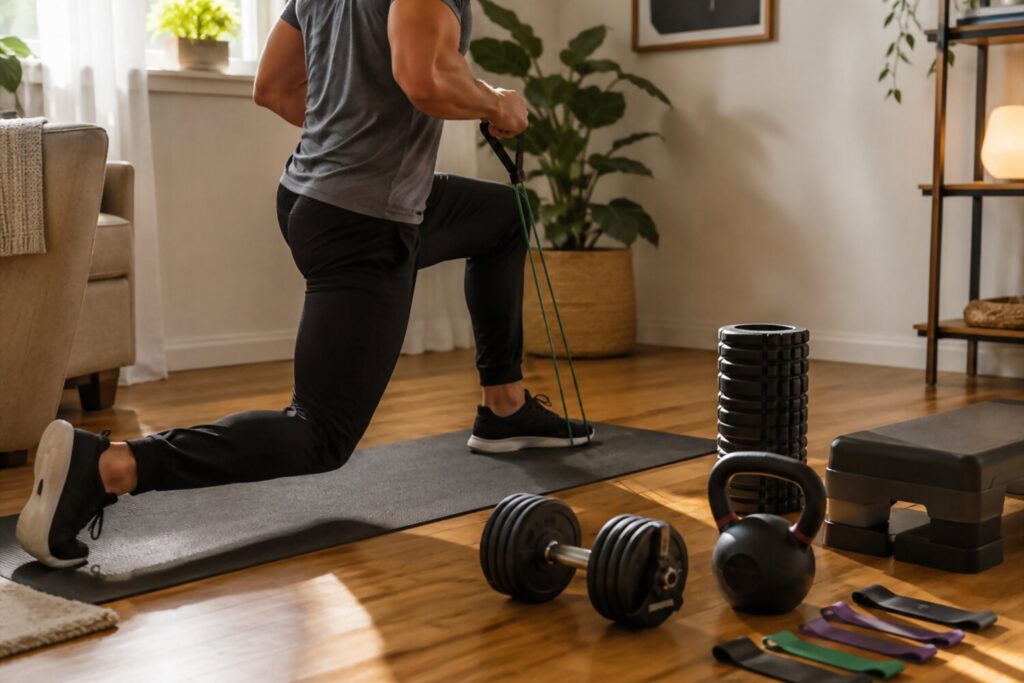
In a compact workout area, every piece of equipment has to earn its place. Functional fitness favors tools that can support many movement patterns instead of machines designed for only one task. This is why versatility becomes more valuable than size. A single adjustable dumbbell, resistance band, kettlebell, or suspension trainer can create dozens of training options without requiring a dedicated room.
Bulky equipment often creates a fixed training environment. It takes up floor space, limits how the room can be used, and may only serve one narrow purpose. Compact functional tools work differently. They can be moved, stored, combined, and adjusted depending on the type of session. One small setup can support strength training, mobility work, balance drills, core movements, and conditioning circuits.
The most useful small-space equipment usually shares a few qualities:
- Multiple uses: the same item can support pushing, pulling, hinging, squatting, carrying, or stabilization work.
- Adjustable challenge: resistance, load, height, grip, or body position can be changed.
- Simple storage: the item can fit in a closet, basket, drawer, corner, or under a bed.
- Low setup time: equipment that is easy to access is more likely to become part of a consistent routine.
- Room compatibility: the tool makes sense for the available floor space, ceiling height, flooring, and noise level.
This rule also helps separate practical purchases from impulse buys. Some fitness products look impressive but are difficult to store or limited in use. A compact item with five or six possible applications often provides more value than a large machine with one movement path. The best small-space tools are not just smaller versions of gym equipment; they are flexible pieces that expand what the room can do.
Versatile equipment also makes training easier to adapt. The same tool can be used for slow strength-focused movements, controlled mobility work, balance challenges, or faster conditioning intervals. This variety is especially useful in homes where the workout area may also function as a living room, bedroom, office, or shared family space.
Small-space fitness is not about having less. It is about choosing equipment that does more. When every item can serve several purposes, even a limited area can feel organized, efficient, and capable of supporting a wide range of functional movement.
Compact Strength Builders That Do More Than One Job
Strength equipment for small spaces works best when it can support several movement patterns without creating clutter. Instead of relying on large machines with fixed paths, compact functional tools allow resistance to move with the body. This makes them useful for movements that resemble everyday actions: lifting from the floor, carrying objects, reaching overhead, stepping, rotating, and stabilizing the trunk.
Adjustable dumbbells are one of the most space-efficient strength options because they replace several pairs of traditional weights. Their main value is range: the same pair can be used for lower-body movements, upper-body pressing, pulling variations, loaded carries, and core-focused exercises. For small apartments or multipurpose rooms, this type of equipment offers strength variety without a full rack.
Kettlebells bring a different kind of versatility. Their offset shape changes how the weight feels in the hand, which makes them useful for grip strength, posture control, hip-driven movements, and full-body coordination. A kettlebell can support slow strength movements as well as more dynamic patterns, giving it a strong role in functional training.
Resistance bands are among the easiest tools to store, but their value goes beyond convenience. Bands create tension that changes throughout a movement, which can make them useful for pulling patterns, shoulder work, warmups, controlled strength exercises, and mobility-focused training. They are especially helpful in small spaces because they weigh very little and can fit in a drawer or travel bag.
Suspension trainers use body weight and leverage instead of stacks of plates or large frames. By changing body angle and foot position, the same straps can create different levels of challenge. They are commonly used for rows, supported squats, presses, lunges, planks, and rotational movements. Their compact design makes them a strong example of how functional training can use simple equipment to create many options.
Other compact strength tools can also add variety:
- Weighted vests: add load while keeping the hands free.
- Medicine balls: support controlled throws, carries, rotations, and core work when used in suitable spaces.
- Sandbags: mimic the uneven feel of real-world lifting and carrying.
- Foldable benches: expand pressing, rowing, and step-up variations while storing more easily than fixed benches.
The common thread is adaptability. Compact strength builders are valuable because they are not limited to one exercise or one body part. They allow a small training area to support strength, coordination, balance, and stability at the same time. In a limited room, that kind of flexibility matters more than the size of the equipment itself.
Low-Impact Conditioning Tools for Apartments and Shared Spaces
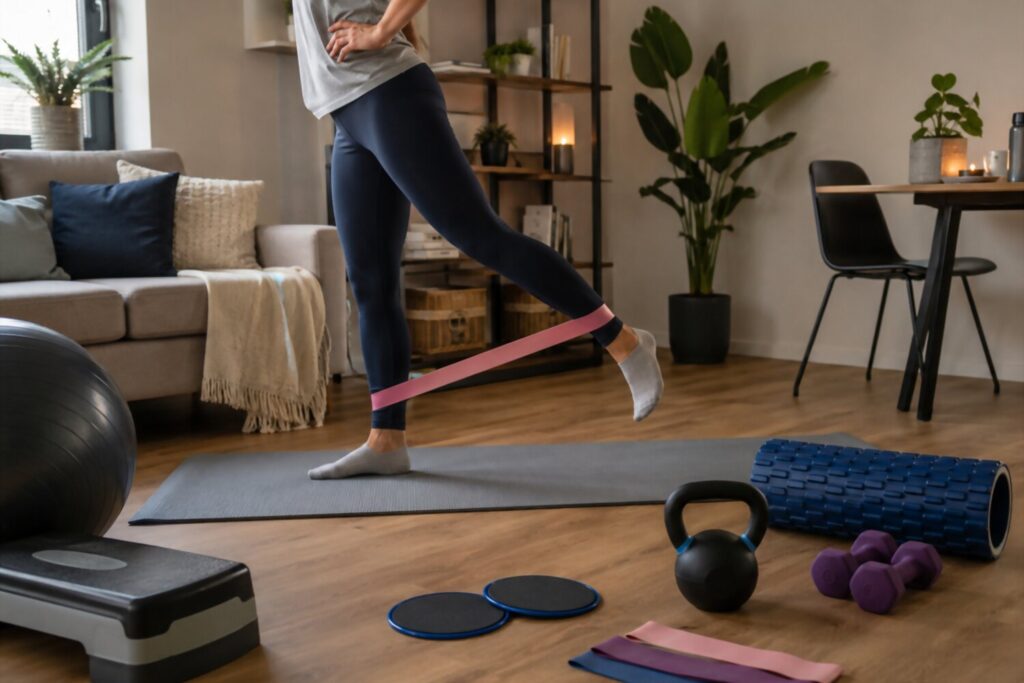
Conditioning equipment for small spaces has a different job than traditional cardio machines. It needs to raise movement variety and training density without taking over the room, shaking the floor, or creating unnecessary noise. In apartments, condos, shared homes, and upstairs rooms, low-impact conditioning tools are especially valuable because they can support heart-rate-focused movement while staying compact and controlled.
Low-impact conditioning does not mean low value. Many compact tools can create steady, rhythmic movement or short bursts of effort without relying on jumping, running, or heavy equipment. This makes them useful for spaces where flooring, neighbors, ceiling height, or room layout limit the type of movement available.
| Tool | Why It Works in Small Spaces | Functional Fitness Value |
|---|---|---|
| Mini stepper | Uses a small footprint and creates a repeatable stepping pattern | Supports lower-body endurance and rhythm |
| Sliders | Fit in a drawer and work on many smooth surfaces | Add challenge to core, lunges, mountain-climber patterns, and controlled transitions |
| Resistance bands | Lightweight, quiet, and easy to store | Create conditioning circuits through pulls, presses, rows, and lateral movements |
| Compact rowing machine | Some models fold or stand vertically | Combines legs, back, arms, and trunk in one repeated pattern |
| Soft medicine ball | Easier to store than large machines | Supports controlled carries, rotations, squats, and core-focused movements |
| Exercise mat | Defines a small movement zone | Supports floor-based conditioning, mobility flow, and bodyweight circuits |
Noise is an important part of small-space conditioning. A tool can be compact but still unsuitable for a shared building if it creates repeated impact or vibration. This is why controlled movements often fit better than high-impact drills. Sliders, bands, steppers, and mat-based sequences can create a strong conditioning effect through continuous motion, tempo changes, and full-body involvement rather than loud or forceful movement.
Another advantage of low-impact tools is how easily they can be combined. A mat and a pair of sliders can support core-focused conditioning. Bands can add pulling or pressing patterns to a bodyweight sequence. A mini stepper can provide steady movement between strength sets. These combinations help a small area feel more dynamic without adding much storage demand.
Low-impact conditioning equipment also expands the meaning of cardio. It is not limited to treadmills, bikes, or large machines. In functional fitness, conditioning can come from repeated carries, controlled transitions from floor to standing, band-resisted movement, rotational patterns, and full-body sequences. The result is a style of training that connects endurance with coordination, posture, balance, and strength.
For small homes, the most practical conditioning tools are often the quietest and simplest ones. They create movement options without turning the room into a gym or disturbing the rhythm of the household.
Mobility, Recovery, and Core Tools Worth the Storage Space
Small-space fitness is often associated with strength and conditioning equipment, but mobility, recovery, and core tools can be just as valuable. These items usually take up very little room, yet they support the movement quality behind nearly every functional pattern. Squatting, reaching, lifting, rotating, balancing, and carrying all depend on how well the body can control position, create tension, and move through comfortable ranges.
Mobility tools help define this part of training. A quality exercise mat creates a dedicated surface for floor-based movement, stretching, breathing work, and controlled transitions. Mobility sticks, light bands, and yoga blocks can support positioning, alignment awareness, and gradual range-of-motion work. Their value is not in complexity, but in how they make small, precise movement more accessible in a compact area.
Recovery tools also fit naturally into small spaces. Foam rollers, massage balls, and compact massage sticks are easy to store and commonly used for self-myofascial release, warmup preparation, and post-session relaxation. These tools are not replacements for medical care, but they can be part of a general wellness setup that helps people pay closer attention to muscle tension, posture, and comfort.
Core-focused tools deserve a place in the conversation because functional fitness relies heavily on trunk control. The core is involved when the body resists rotation, transfers force, carries weight, stabilizes the spine, or changes direction. Compact tools such as sliders, ab wheels, balance pads, and stability balls can add variety to this work without requiring a large machine.
Useful small-space tools in this category include:
- Exercise mat: creates a clean, defined area for floor movement, stretching, and bodyweight work.
- Foam roller: supports general soft-tissue work and cooldown routines.
- Massage ball: reaches smaller areas than a roller and stores easily.
- Sliders: add challenge to core, mobility, and controlled lower-body patterns.
- Yoga blocks: support modified positions and make floor-based movement more adaptable.
- Balance pad: adds instability for balance, ankle control, and posture-focused movements.
- Ab wheel: offers a compact way to train trunk tension and control.
What makes these tools especially practical is their storage-to-value ratio. Many can fit in a basket, closet, drawer, or corner, yet they expand the usefulness of the entire training space. A mat can turn a living room floor into a mobility area. A pair of sliders can change the feel of familiar movements. A balance pad can make simple positions more demanding.
In functional fitness, movement quality matters as much as effort. Compact mobility, recovery, and core tools help round out a small-space setup by supporting control, comfort, awareness, and variety. They may not look as impressive as large machines, but they often become the quiet essentials that make the space feel complete.
Sample Small-Space Setups by Budget and Room Size
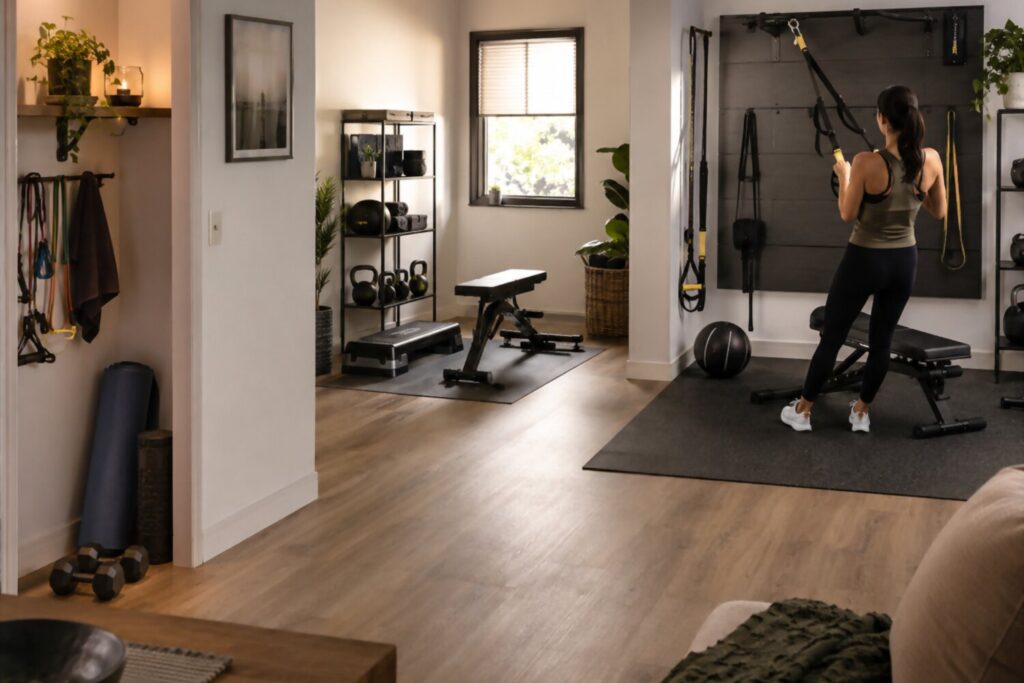
A small-space fitness setup becomes easier to understand when it is viewed as a system rather than a pile of separate products. The most effective combinations usually include tools for strength, mobility, conditioning, and storage efficiency. The exact setup depends on the room, budget, noise limits, and how many people use the space.
Minimal setup: a mat, resistance bands, and sliders.
This combination works well for very small rooms, apartments, dorms, offices, and travel-friendly spaces. A mat defines the training area, bands add adjustable resistance, and sliders create controlled movement challenges for the core, legs, and transitions. Together, these items can fit in a closet, drawer, or tote bag while still supporting a wide range of functional patterns.
Apartment-friendly setup: adjustable dumbbells, bands, mat, and foam roller.
This setup adds more strength potential while staying compact and relatively quiet. Adjustable dumbbells support squats, hinges, presses, rows, carries, and lunges. Bands expand pulling and mobility options, while the mat and foam roller create a useful space for warmups, floor-based movement, and recovery. This combination suits multipurpose rooms because most items can be stored vertically or tucked away after use.
Strength-focused setup: kettlebell, adjustable dumbbells, foldable bench, and mobility tools.
For someone prioritizing strength variety in a small home gym corner, this layout offers more loading options without requiring large machines. The kettlebell adds grip, hip-drive, and full-body coordination patterns. Adjustable dumbbells provide broader weight selection, while a foldable bench expands pressing and rowing variations. Mobility tools help balance the setup by supporting range of motion, positioning, and movement quality.
Low-noise conditioning setup: mini stepper, bands, sliders, and exercise mat.
In shared buildings, the most useful conditioning tools are often quiet, compact, and controlled. A mini stepper creates steady lower-body movement with a small footprint. Bands and sliders add variety through upper-body, lateral, core, and transition-based patterns. The mat helps define the space and can reduce direct contact with the floor.
Premium compact setup: adjustable dumbbells, suspension trainer, foldable bench, mat, and compact cardio tool.
This setup is for a dedicated corner, spare bedroom, or small garage area. It covers the largest range of functional fitness categories while still avoiding oversized machines. The suspension trainer adds bodyweight leverage, the dumbbells and bench support strength work, the mat supports mobility and floor movement, and the compact cardio tool adds conditioning variety.
A useful way to compare these setups is by the role each item plays:
- Foundation: mat, storage bin, wall hooks, floor protection.
- Strength: adjustable dumbbells, kettlebell, weighted vest, foldable bench.
- Movement variety: bands, sliders, suspension trainer.
- Conditioning: mini stepper, compact rower, low-impact circuits.
- Mobility and recovery: foam roller, massage ball, yoga blocks.
The best small-space setup is rarely the one with the most equipment. It is the one where each piece has a clear role and works well with the available room. When a setup includes tools that complement one another, even a narrow corner can support a surprisingly complete functional fitness experience.
How to Store, Use, and Rotate Equipment Without Clutter
In a small fitness space, organization matters almost as much as the equipment itself. Functional tools are usually compact, but they can still create clutter if they are scattered across the room. A well-organized setup makes the space feel intentional, keeps equipment visible enough to be used, and allows the room to return to its everyday purpose after activity.
Storage works best when it matches the shape of the equipment. Flat items such as mats, sliders, and bands can fit into narrow spaces, while heavier tools such as dumbbells and kettlebells usually need low, stable storage. Long items, including mobility sticks or suspension straps, often work well with vertical storage. When each piece has a clear place, the room feels less crowded even when the equipment collection grows.
Common small-space storage categories include:
- Vertical storage: wall hooks, pegboards, over-door racks, and narrow shelving.
- Hidden storage: under-bed bins, storage benches, baskets, and closet corners.
- Floor protection zones: mats or tiles that define where movement and equipment use happen.
- Portable storage: totes, rolling carts, and handled bins for equipment used in shared rooms.
- Display storage: open shelves for attractive or frequently used items, such as bands, yoga blocks, or massage tools.
Rotation is another useful concept for small spaces. Not every item has to be available at all times. A functional fitness setup can shift by training focus: strength tools during one phase, mobility and recovery tools during another, or conditioning equipment when the goal is more endurance-based movement. This keeps the space visually lighter while still allowing variety over time.
Clutter often comes from overlap. Several tools may serve the same role, while one versatile item could cover multiple needs. For example, resistance bands can support strength, mobility, warmups, and conditioning. A mat can define the training area, protect the floor, and support recovery work. Sliders can add difficulty to core, lower-body, and transition-based movements. Recognizing these overlapping uses helps explain why functional fitness equipment works so well in compact rooms.
The best small-space setups feel easy to reset. After a session, equipment that returns quickly to a shelf, hook, basket, or corner helps the room stay livable. This matters in apartments, bedrooms, offices, and shared family spaces where the workout zone may disappear back into daily life within minutes.
A compact fitness area does not need to look empty to feel organized. It needs clear zones, practical storage, and equipment with purpose. When tools are easy to access, easy to put away, and useful in more than one way, even a small corner can support a complete and clutter-free functional fitness routine.
Key Takeaways
Functional fitness equipment works especially well in small spaces because it emphasizes movement variety over machine size. The most valuable pieces are usually the ones that support several patterns, such as pushing, pulling, squatting, hinging, carrying, rotating, balancing, and controlled floor movement.
A compact setup can feel surprisingly complete when it includes a few core categories:
- Strength tools such as adjustable dumbbells, kettlebells, resistance bands, or suspension trainers.
- Conditioning tools such as sliders, mini steppers, compact rowers, or band-based circuits.
- Mobility and recovery tools such as mats, foam rollers, massage balls, yoga blocks, and mobility sticks.
- Storage solutions such as wall hooks, baskets, under-bed bins, shelves, or rolling carts.
The main advantage of small-space functional fitness is efficiency. A single mat can define the workout area, protect the floor, and support mobility or recovery work. A set of resistance bands can add pulling, pressing, warmup, and conditioning options. Adjustable weights can replace several pairs of traditional dumbbells while keeping the room open and usable.
The best small-space fitness setup is not the one with the most equipment. It is the one where every item has a clear purpose and supports more than one type of movement.
Small rooms do not have to limit training variety. With thoughtful equipment choices, even a bedroom corner, office nook, apartment living room, or garage wall can become a practical functional fitness zone without feeling crowded.