How To Measure Body Fat Percentage At Home
Why Body Fat Percentage Matters More Than the Scale
Most people grow up believing that weight is the ultimate measure of health. You step on a scale, see a number, and assume it tells the whole story. It does not.
Body weight is simply the total mass of everything in your body, including muscle, fat, water, bones, and even the food you recently ate. This means your weight can change for reasons that have nothing to do with fat gain or fat loss. A salty meal, dehydration, or a hard workout can shift that number quickly. Because of this, relying only on the scale can create confusion and frustration.
Body fat percentage gives a clearer picture because it separates fat mass from lean mass. Lean mass includes muscles, organs, bones, and fluids, all of which are essential for health and performance. When you know your body fat percentage, you can better understand what your body is actually made of, not just how much it weighs.
Two people can weigh the same and look completely different. This is not an exaggeration. A person with higher muscle mass will usually appear more defined and firm, while someone with higher body fat may look softer even if the scale shows identical numbers. Muscle is denser than fat, so it takes up less space in the body.
Here is a simple comparison to illustrate the difference:
| Measurement Type | What It Tells You | Limitation |
|---|---|---|
| Body Weight | Total mass of the body | Does not separate fat and muscle |
| Body Fat Percentage | Proportion of fat vs lean tissue | Requires method to estimate |
The scale also does not reflect important health markers linked to body composition. Higher body fat levels, especially around the abdomen, are associated with increased risks of metabolic conditions. On the other hand, maintaining a healthy level of body fat supports hormone balance, energy levels, and overall physical function. This makes body fat percentage a more meaningful indicator for long term health.
Another important factor is progress tracking. If you are exercising regularly, especially with strength training, you might gain muscle while losing fat. In this situation, your weight could stay the same or even increase slightly. Without body fat measurements, it may seem like no progress is happening, even though your body composition is improving significantly.
Focusing only on weight can lead to misleading decisions. Someone might reduce calories too aggressively just to see the number drop, potentially losing muscle along with fat. By paying attention to body fat percentage instead, the goal shifts toward preserving lean mass while reducing excess fat, which is a more balanced and sustainable approach.
Understanding body fat percentage changes how you interpret your results. It moves the focus away from a single number and toward a deeper awareness of how your body is changing over time.
The Mirror Test: What Your Body Is Quietly Telling You

Stand in front of a mirror. Not for judgment, but for observation.
The human eye is surprisingly good at detecting patterns, especially when you look at your own body regularly. While it cannot give you an exact percentage, it can reveal trends in fat distribution, muscle tone, and overall composition. This is why visual assessment has been used for decades in fitness and health. It becomes even more powerful when combined with consistency and honesty.
Instead of focusing on flaws, shift your attention to specific markers. These markers tend to change in predictable ways as body fat levels increase or decrease. When you learn what to look for, the mirror becomes a useful feedback tool rather than a source of frustration.
What to Look For in the Mirror
- Definition in the midsection
Visible outlines of abdominal muscles usually indicate lower body fat levels. A smooth or soft appearance in this area often reflects higher fat storage. - Shape of the waist and hips
A more defined waistline compared to the hips or chest often signals lower body fat. Less contrast between these areas can suggest higher levels. - Muscle separation in arms and legs
Clear separation between muscle groups appears as body fat decreases. When body fat is higher, muscles tend to look less distinct. - Facial structure
The jawline and cheekbones can become more defined as body fat decreases. Increased softness in the face may indicate higher fat levels. - Lower back and abdominal area
These regions tend to store fat more stubbornly. Changes here often happen more slowly and can provide clues about overall progress.
Small changes matter. A slightly sharper jawline, a bit more contour in your arms, or subtle definition in your legs can signal real progress even if the scale does not move.
Your body also stores fat differently depending on genetics, sex, and hormones. Some people carry more fat around the abdomen, while others store it in the hips or thighs. This means two individuals with the same body fat percentage might still look different. Recognizing your personal pattern helps you interpret what you see more accurately.
Lighting, posture, and timing can affect what you see in the mirror. Natural light tends to show more detail than artificial light. Standing relaxed versus flexing your muscles creates a different appearance. Even the time of day matters, since factors like hydration and food intake can slightly change how your body looks.
For better consistency, try observing yourself under similar conditions each time. Use the same mirror, similar lighting, and a relaxed posture. This reduces variables and makes it easier to notice real changes rather than temporary fluctuations.
The mirror does not give you numbers. It gives you context.
The Tape Measure Method That Actually Works
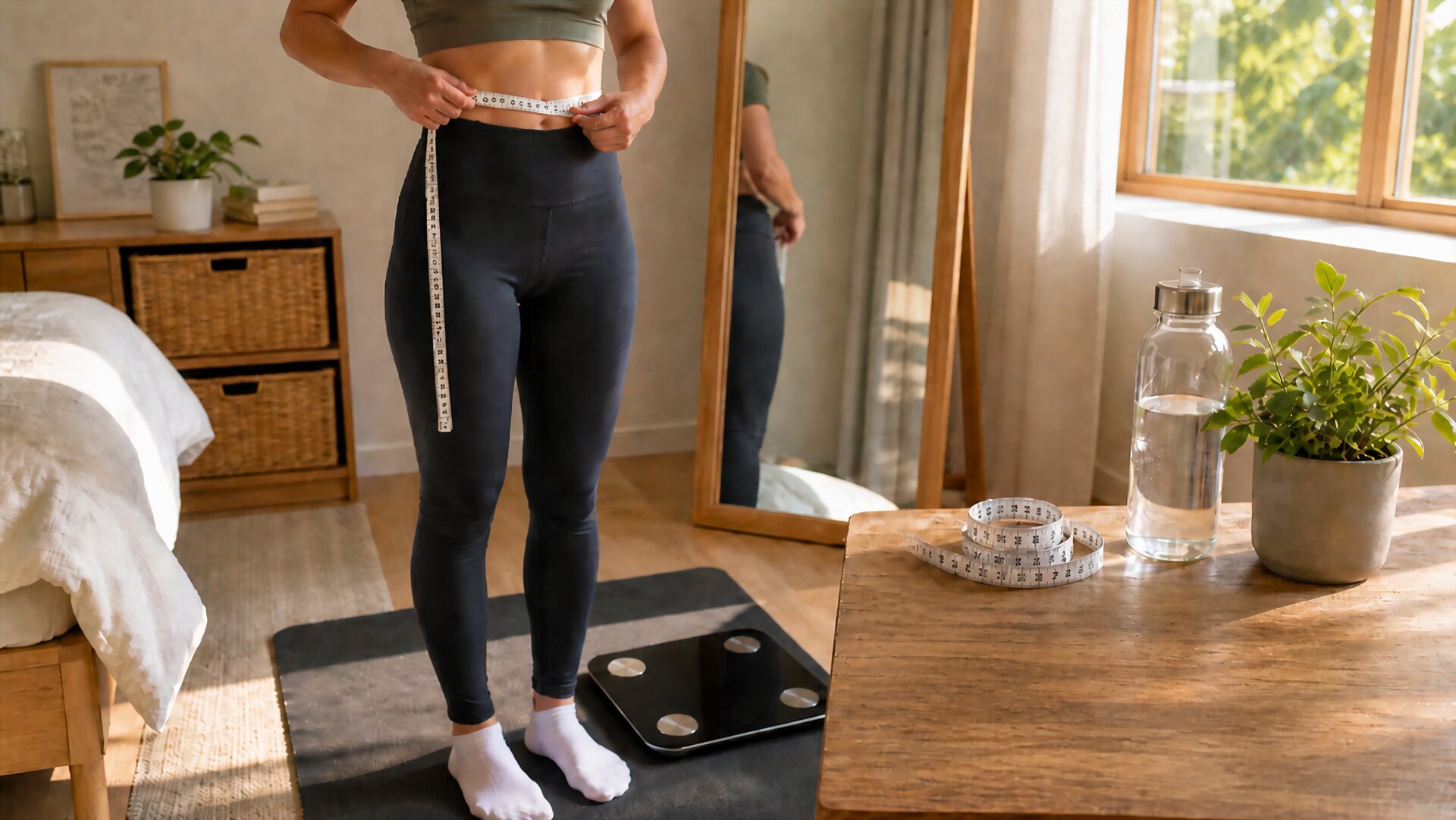
A simple measuring tape can tell you far more than you might expect.
Unlike the scale, a tape measure focuses on how your body is shaped. It tracks changes in size and proportion, which are closely linked to body fat levels. This method has been used in fitness, health assessments, and even military evaluations because it is practical and accessible. While it does not directly measure body fat, it allows you to estimate it with reasonable accuracy when done correctly and consistently.
You do not need expensive equipment. You need precision.
How to Take Your Measurements Correctly
Follow these steps carefully to get reliable results:
- Use a flexible tape measure
It should sit flat against your skin without twisting. - Measure at the same time of day
Your body can change slightly throughout the day due to food and water intake. - Stand relaxed, not flexing
Tightening muscles will distort the measurement. - Keep the tape snug but not tight
It should not press into the skin. - Record your numbers immediately
Small differences matter over time.
Consistency is more important than perfection. Even small errors become less important if you measure the same way each time.
Key Areas You Need to Measure
Different formulas use different points, but the most common and effective locations include:
- Waist
Measure around your natural waistline, usually just above the belly button. - Neck
Measure just below the Adam’s apple, keeping the tape level. - Hips
For women, measure the widest part of the hips.
These measurements are often used in widely accepted estimation formulas because they reflect how fat is distributed in the body. The waist, in particular, is strongly linked to overall body fat levels and health risk.
Turning Measurements Into an Estimate
Once you have your numbers, you can use established formulas to estimate body fat percentage. These formulas were developed using large population studies and provide a practical approximation. They are not perfect, but they are useful when applied consistently.
For example, methods based on waist and neck measurements can reflect changes in fat levels over time, especially around the midsection. As your waist measurement decreases while other measurements stay stable, it often indicates fat loss.
Common Mistakes That Change Your Results
Many people unknowingly reduce the accuracy of their measurements. These are the most frequent issues:
- Measuring in different locations each time
- Pulling the tape too tight or leaving it too loose
- Changing posture between measurements
- Measuring over thick clothing instead of directly on the skin
Even small inconsistencies can create misleading results. The goal is not to get a perfect number once, but to see a clear trend over time.
A measuring tape does not guess. It reflects change.
Smart Scales: Are They Worth the Hype?
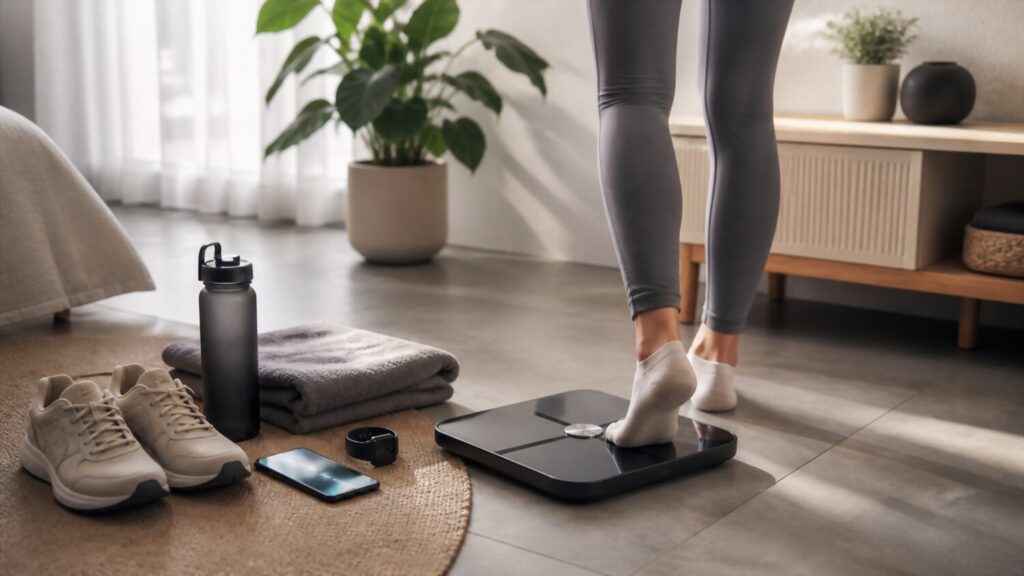
Step on the scale. Wait a few seconds. Suddenly, you see not just your weight, but also body fat, muscle mass, water level, and more.
It feels advanced, almost like a mini health lab in your bathroom. But how much of that information is actually reliable?
Smart scales use a method called bioelectrical impedance. A very small, safe electrical signal passes through your body, usually from one foot to the other. This signal travels differently through fat, muscle, and water. Muscle contains more water and conducts the signal more easily, while fat slows it down. Based on how fast the signal moves, the scale estimates your body composition.
It sounds scientific because it is based on real principles. However, the accuracy depends on several factors that are often overlooked. Hydration level, recent meals, exercise, and even skin temperature can influence the reading. This means the same person can get different results within hours without any real change in body fat.
What Smart Scales Do Well
Smart scales can still be useful when used correctly. Their strength is not perfect accuracy, but consistency over time.
- They provide quick and easy measurements at home
- They help track trends instead of single readings
- They often store data, making progress easier to monitor
When you use the scale under similar conditions, such as in the morning before eating, the results become more meaningful. The numbers may not be exact, but the direction of change often reflects reality.
Where Smart Scales Fall Short
There are important limitations to understand before relying on these devices:
- They estimate body fat, not measure it directly
- Readings can vary based on hydration and recent activity
- Lower body measurements may not reflect upper body composition
For example, if you drink a large amount of water, the scale may show a lower body fat percentage because your body conducts electricity more easily. After intense exercise, changes in fluid distribution can also affect the result. These fluctuations are normal but can be confusing if you expect stable numbers.
How to Use a Smart Scale the Right Way
The key is not to chase accuracy, but to control variables as much as possible. Try to weigh yourself under the same conditions each time. Morning is often the best moment because your body is in a more stable state. Avoid measuring right after eating, drinking large amounts of fluids, or exercising.
Pay attention to patterns. If your body fat reading gradually decreases over weeks, even with small daily variations, that trend is likely meaningful. If the number jumps up or down suddenly, it is often due to temporary changes rather than real fat gain or loss.
Smart scales are tools. Their value depends on how you use them.
The Pinch Test: Can Skinfold Measurements Be Trusted at Home?
At first glance, the idea seems simple. Pinch the skin, measure the thickness, and estimate body fat.
This method is known as skinfold measurement. It has been used for many years in fitness and research settings to estimate body fat percentage. The concept is based on the fact that a portion of body fat is stored just under the skin. By measuring the thickness of these layers at specific points, it is possible to estimate overall body fat.
However, the accuracy of this method depends heavily on technique.
How the Skinfold Method Works
Skinfold measurements focus on specific areas of the body where fat tends to accumulate in a predictable way. These measurements are then entered into equations developed from population studies. The result is an estimate, not a direct measurement, of body fat percentage.
Common measurement sites include:
- Chest or upper torso
- Abdomen
- Thigh
- Triceps
- Area below the shoulder blade
Each site provides a piece of the overall picture. When combined, they create a more complete estimate of body fat distribution.
Why Technique Matters So Much
This method is highly sensitive to how the measurement is taken. Even small differences in finger placement or pressure can change the result. The thickness of the skinfold must be separated from the underlying muscle, which is not always easy without practice.
In professional settings, trained individuals spend time learning how to identify the exact locations and apply consistent pressure. At home, this level of precision is harder to achieve. As a result, two measurements taken by the same person on different days may vary, even if body fat has not changed.
Another factor is the type of tool used. Specialized calipers are designed to apply consistent pressure, which improves reliability. Using fingers alone can give a rough sense of change, but it lacks the consistency needed for accurate estimation.
What This Method Can and Cannot Do
| Aspect | Reality |
|---|---|
| Measures fat directly | No, it estimates based on skinfold thickness |
| Accuracy at home | Moderate, depends on consistency and technique |
| Best use | Tracking changes over time |
Skinfold measurements are more useful for observing trends than for determining exact numbers. If measurements are taken in the same way over time, changes in thickness can reflect changes in body fat. If the method varies, the results become harder to interpret.
Understanding Variability
The body does not store fat evenly, and this affects how skinfold measurements reflect total body fat. Some individuals store more fat in the upper body, while others store more in the lower body. Because of this, standard measurement sites may not fully represent every individual’s fat distribution.
Environmental and physical factors can also influence results. Skin temperature, hydration, and even slight swelling in tissues can change how the skinfold feels and measures. These factors do not reflect true changes in fat but can still affect the reading.
The pinch test is based on a real scientific principle. Its reliability depends less on the method itself and more on how consistently it is applied.
The Consistency Rule: Why Your Method Matters More Than Accuracy
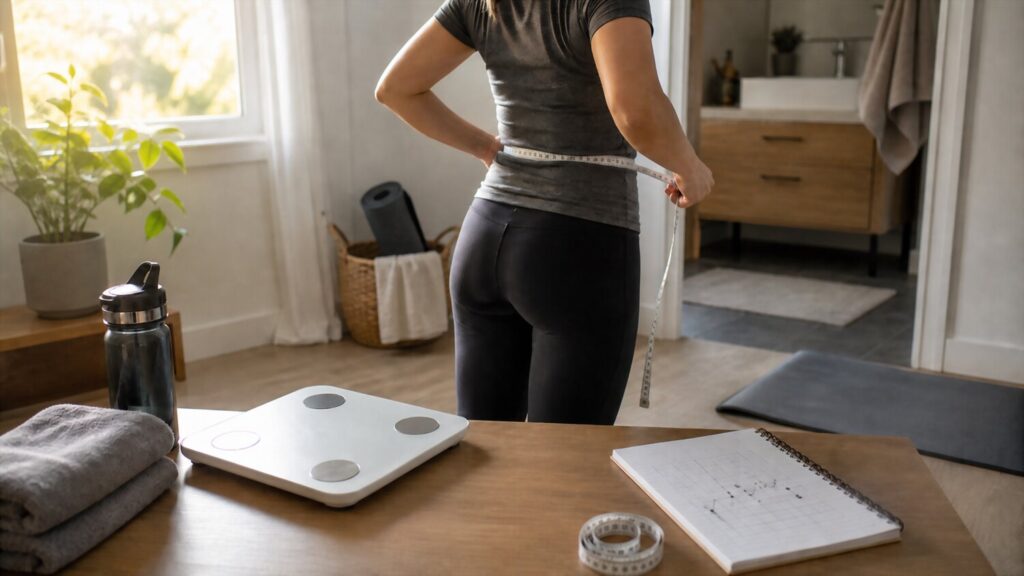
Body fat measurement can feel like a search for the perfect number. One device says 24 percent. Another formula says 21 percent. A visual estimate suggests something different.
That does not always mean one method is useless. It often means each method is measuring or estimating body composition in a different way. Home methods are especially sensitive to small variables, including hydration, posture, timing, food intake, and measurement technique. Because of this, a single reading is rarely the most important part of the process.
The real value comes from repeated measurements under similar conditions.
Why One Reading Can Be Misleading
Body fat does not change dramatically overnight, but measurements can. A smart scale may show a different result after a salty meal because water balance shifts. A tape measurement may change slightly if the tape is placed a little higher or lower. A skinfold reading may vary because of pressure, angle, or skin temperature.
These changes can look meaningful even when they are not. This is why a single number can create unnecessary confusion. One reading captures a moment, not a full pattern.
The trend matters more than the snapshot.
A method that is not perfectly accurate can still be useful if it is consistent. For example, if a tape measure underestimates or overestimates body fat but does so in the same way each time, it can still show whether the body is changing. The number may not be exact, but the direction can be informative.
| Measurement Situation | What It May Show | What It May Not Show |
|---|---|---|
| One isolated reading | A temporary result | A reliable trend |
| Repeated measurements | Direction of change | Perfect body fat percentage |
| Different methods mixed together | Conflicting estimates | Clear progress pattern |
This is where many people get stuck. They compare numbers from different tools as if they should match exactly. A smart scale, tape measure formula, and skinfold estimate may all produce different percentages because they rely on different assumptions. None of them should be treated as a flawless truth when used at home.
Why Using the Same Method Matters
When the same method is repeated in the same way, random fluctuations become easier to recognize. A sudden jump may be noise. A steady change over several weeks is more meaningful.
This applies to every home method. A mirror assessment becomes more useful when lighting and posture stay similar. A tape measure becomes more useful when the same body points are measured each time. A smart scale becomes more useful when readings are taken under similar conditions. Skinfold measurements become more useful when the same sites and pressure are used.
The body is dynamic. Water, digestion, exercise, sleep, and hormones can all influence short term measurements. These factors do not always reflect fat gain or fat loss. Looking at patterns reduces the chance of mistaking normal fluctuations for real body composition changes.
Consistency also changes the emotional experience of tracking. Instead of reacting to every number, the focus shifts to observing movement over time. This makes the process more educational and less dramatic. It turns body fat measurement into a record of patterns, not a daily verdict.
A method does not need to be perfect to be useful. It needs to be repeatable.
Turning Numbers Into Results: What to Do After You Measure
A body fat estimate is not a grade. It is a piece of information.
Once you have a number, the next step is understanding what it actually means. A body fat percentage can help explain changes in appearance, fitness progress, and health risk, but it does not define the whole person. It should be viewed alongside strength, energy, sleep, waist size, medical history, and overall lifestyle.
Context matters.
A lower body fat percentage is not automatically better for everyone. The body needs essential fat for hormone production, temperature regulation, nutrient absorption, and basic physical function. Very low body fat levels can be risky, especially when paired with fatigue, poor recovery, irregular menstrual cycles, low mood, or constant hunger. On the other side, higher body fat levels, especially around the abdomen, can be linked with greater metabolic risk.
Reading the Number Without Overreacting
The most useful question is not “Is this number perfect?” It is “What pattern is this number part of?”
One measurement can be affected by water, digestion, measurement technique, and the device used. A number that moves slightly from one day to the next does not always mean fat has changed. Fat loss and fat gain usually show up through repeated patterns over time, not sudden daily swings.
This is where tracking becomes practical. If the estimate slowly moves in one direction over several weeks, and other signs match that pattern, the number becomes more meaningful. A shrinking waist, better clothing fit, improved strength, and stable energy can all help confirm that progress is real. If the body fat estimate changes but everything else stays the same, the result may be measurement noise.
How Goals Change the Meaning
Different goals change how body fat data is interpreted. Someone focused on general health may care most about staying within a sustainable range and keeping waist size in check. Someone building muscle may accept little change on the scale if strength improves and measurements shift. Someone training for performance may need enough body fat to support recovery, hormones, and energy availability.
A single “ideal” number does not apply to everyone. Age, sex, genetics, training history, and health conditions all affect what is realistic and appropriate. Athletes, beginners, older adults, and people returning from long breaks can all have different body composition needs.
The number becomes most useful when it is connected to a clear purpose. Without a purpose, it is easy to chase smaller percentages without knowing whether that change is actually beneficial.
What Changes Usually Mean
A lower body fat estimate with stable or improved strength often suggests fat loss while lean mass is being preserved.
A lower body weight with falling strength and low energy may suggest that the body is losing more than just fat.
A stable weight with a smaller waist can suggest body recomposition, where fat decreases while lean mass increases or stays steady.
A higher body fat estimate after salty food, hard exercise, or poor sleep may reflect short term fluid changes rather than true fat gain.
Body composition is not only about removing fat. It is also about protecting muscle, supporting normal body function, and building habits that can last. When the focus becomes too narrow, people may overlook important signals such as recovery, mood, hunger, training quality, and overall health.
When the Number Needs More Careful Attention
Body fat estimates at home are not medical diagnoses. They are approximations. If a number seems unusually low or high, or if it comes with concerning symptoms, it belongs in a broader health conversation rather than being treated as a final answer.
This is especially important for people with a history of disordered eating, pregnancy, chronic illness, recent surgery, hormonal conditions, or unexplained weight changes. In these cases, body composition data can be emotionally or medically complex. A health professional can interpret the number with more context than any home method can provide.
The most valuable result is not always the smallest number. Sometimes it is a steadier pattern, better strength, a healthier waist measurement, improved daily energy, or a clearer understanding of how the body responds over time.
References
- Body fat percentage: Explains what body fat percentage means and covers common estimation methods, including calipers, bioelectrical impedance, and anthropometric formulas.
- Body composition: Supports the article’s discussion of fat mass, lean mass, water, muscle, and why weight alone can be misleading.
- Bioelectrical impedance analysis: Describes the method used by many smart scales to estimate body composition.
- Anthropometry: Relates to tape measurements, body dimensions, and circumference based estimation methods.
- Waist to height ratio: Gives context for waist measurement and abdominal fat distribution.